
Program FAQs
To close the gaps in life expectancy and health equity that exist within and between every country in the world, we need more robust leadership in both the technical and the moral issues related to health and well-being.
The Atlantic Fellows for Health Equity (AFHE) program is dedicated to training those leaders – individuals who will have health equity as their mindset and health disparities reduction as their explicit skillset. With this philosophy and support from the Atlantic Philanthropies, the Atlantic Fellows for Health Equity team at the Fitzhugh Mullan Institute for Health Workforce Equity designed, and in January 2017, launched the Leaders for Health Equity fellowship program, now called the Atlantic Fellows for Health Equity at the George Washington University.
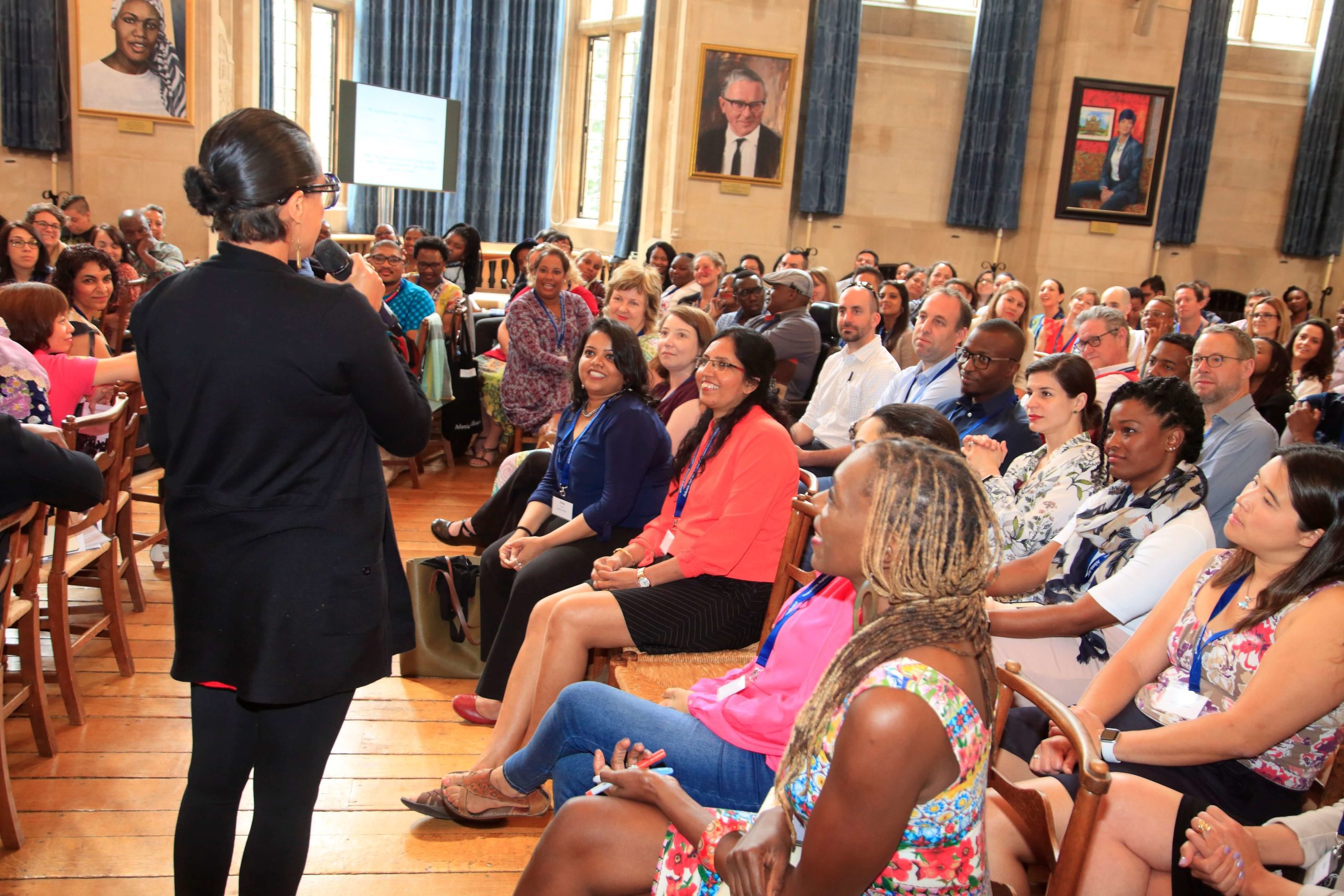
This is a one-year fellowship. There are in-person meetings, called convenings, throughout the year that represent a total anticipated time commitment of four weeks. Convenings are full-time, out of office commitments that take place in different parts of the world. In between convenings, there is an online curriculum taught by the AFHE program faculty. These online trainings take place every two weeks for two hours. There is an additional time commitment for self-directed learning of 12-16 hours per month. Self-directed learning activities include completion of program readings, videos and assignments. Assignments may be related to your individual project, reflection and/or program evaluation. Attendance and participation for both in-person and online coursework is required for successful completion of the program.
Fellows must be in their early to mid-career and want to become more effective leaders and work with others to achieve change. Fellows should be currently engaged in health-related work in a leadership role or in a position that has potential for leadership.
In order to address important determinants of health beyond biology and healthy behaviors, we need to involve people and sectors beyond traditional healthcare and public health, as we do in this fellowship program.
There are no specific educational requirements or ‘preferred’ professions – we are a community united by values. The shared attributes and values of the Atlantic Fellows for Health Equity include action/solutions orientation, equity, inclusivity, courage, curiosity, humility, diversity and creativity. If you share these values, we encourage you to apply.
Fellows are inducted into the Atlantic Fellows lifelong community after they complete their fellowship year. Lifelong fellows continue to have access to an international network of leaders committed to combating inequity in their communities. They are invited to participate in global interest groups, seminars and conferences, as well as collaborate with other Atlantic Fellows on equity-focused projects.
Fellows do not receive a stipend for this program. They are expected to remain employed throughout the fellowship so that leadership lessons are applied in real-life scenarios. All educational experiences and travel expenses related to participation in this fellowship including in-person convenings are paid for by Atlantic Fellows for Health Equity.
Please contact [email protected]. You can also follow us on Instagram, Facebook and LinkedIn.
Application FAQs
The Atlantic Fellows for Health Equity application invites applicants to share their leadership journey, current work, and aspirations through a combination of short written responses and brief recorded video questions. Together, these components offer applicants multiple ways to reflect on the experiences, values, and perspectives that shape their commitment to advancing health equity, both personally and professionally.
Applicants will respond to questions about their motivation for leadership, the communities they serve, the impact of their work to date and a project they hope to advance during the fellowship year. The application also asks applicants to reflect on collaboration, challenge, and learning through a small number of video responses, and to share their vision for the future, both for their community and for their continued leadership after the fellowship. More details on the application requirements can be found here.
You do NOT need to be a health professional to apply for this fellowship. We are looking to recruit fellows who are currently engaged in health-related work including, but not limited to: finance, economics, art, architecture, academia, government, public health, law, media, technology and healthcare delivery. We encourage those with diverse backgrounds and experiences to apply. There are no educational/degree requirements for the fellowship program.
Yes, but you need to have some area of active work and engagement with health equity so that you can really dive into the fellowship curriculum.
There are no educational/degree requirements for the fellowship program. Discussions will include advanced concepts and terminology in health equity, but we recognize that many leaders in the field have obtained advanced knowledge in non-traditional ways.
We are excited to welcome entrepreneurs and organizational leaders to the program. If you run your own organization, please have a member of your Board of Directors or equivalent advisor/stakeholder complete the letter of support and at least one letter of recommendation. The other letter of recommendation may come from a professional contact familiar with your work outside your organization. Please note that letters of recommendation should not come from people that report to you.
U.S. Citizenship is not a requirement for this fellowship program. We welcome and encourage applicants from all countries. Fellows do need to be proficient in English and be able to obtain the appropriate Visas to travel internationally to participate in fellowship convenings.
At least 3 years of full-time experience is required. The most important thing is to have a work record that demonstrates a consistent, enduring commitment to health equity.
No, AFHE will not provide funding for project proposals. Applicant project proposals should align with issues on which they or their organization focus. The project is a key part of the overall learning experience.
Yes. We encourage people to apply more than once if they feel like they are a good fit for the program, and to incorporate new health equity experiences into future applications. Beginning in 2026, AFHE will only allow 3 total application attempts per applicant. Any application attempts prior to 2026 will NOT count towards the 3 attempts. However, all application attempts from 2026 onward will count towards the 3-application maximum.
No. The program covers all educational experiences and travel expenses related to participation in the fellowship.
Letters of recommendation should be specific to your interest in being an Atlantic Fellow for Health Equity. They should come from professional references who are willing to be contacted in the final selection process, in addition to providing you a letter of recommendation. At least one of these should be from someone in a direct supervisory role (this can be the same person who completes the employer support form).